 Sunrise Marine
If you're searching for boat detailing in Clearwater Beach, you're already thinking like a smart boat owner. Clearwater Beach puts your vessel through a serious workout every single season. The combination of intense Gulf sun, high salinity from the open water near Clearwater Pass, and the humid salt air that sits over the Mandalay Channel creates conditions that break down gel coat, oxidize fiberglass, and leave salt crystals ground into every surface you can and can't see. Boats kept on lifts, on trailer storage, or tied at slips along the waterway all face the same relentless exposure. Sunrise Marine Detailing LLC handles the full picture, inside and out, so you don't have to manage a punch list of separate tasks. Reach out today to get a free quote and find out what your boat actually needs. We also keep boats clean in neighboring waters like Harbor Bluffs, see our full boat detailing services for the full overview.
Why Clearwater Beach Boats Need Boat Detailing
Clearwater Beach sits at the mouth of a system of waterways that connects Clearwater Harbor, the Intracoastal, and the open Gulf of Mexico. That geography is one of the reasons people love boating here. But that same geography is exactly why boats in this area take a harder beating than vessels kept on freshwater lakes or in more sheltered coastal environments. The salinity levels near Clearwater Pass, where tidal exchange with the Gulf is constant, are significantly higher than you'd encounter even a few miles inland. When salt water dries on your hull, gel coat, or upholstery, it leaves behind crystalline deposits that act like fine sandpaper every time the boat flexes, gets washed lightly, or gets walked across. Over a single Florida summer, that process alone can dull a gel coat finish that looked showroom-new just twelve months prior.
The sun exposure at Clearwater Beach compounds everything. UV intensity in Pinellas County is not something to take lightly. Boats moored near Pier 60 or staged for launch along the barrier island are baking in direct sunlight for the bulk of the day, and UV radiation breaks down the resin matrix in fiberglass gel coat on a molecular level. What you see as "chalky oxidation" is actually the gel coat's surface layer degrading and losing its ability to reflect light properly. That oxidation also means the surface becomes more porous, which means it soaks up stains, bird droppings, fish blood, and bilge residue faster than a well-maintained surface would. A boat that gets regular professional detailing maintains a protective layer of wax or sealant that slows that whole process down considerably. A boat that skips detailing for a season or two often ends up needing compound correction work that is far more labor-intensive than a standard detail would have been.
Storage setup matters too, and Clearwater Beach has a wide variety. Some owners keep their boats on dry storage at local facilities and only splash for the weekend. Others live aboard or keep their vessels in wet slips for extended periods. Boats on wet slips accumulate waterline staining, biological growth at the hull-to-water interface, and consistent splash-zone salt buildup that dry-stored boats don't see as intensely. Conversely, boats on trailers or lifts can develop different problems: road grime and trailer rust transfer on the hull bottom, UV exposure on the topsides and deck without any water cooling effect, and condensation-related mildew inside the cabin and under cushions. We work with all of these storage types and adjust our process based on what your specific boat has been through. Whether your vessel lives on a lift near the Sand Key Bridge area or spends weekends exploring the Mandalay Channel, the detail process starts with understanding your boat's actual condition and history, not a one-size-fits-all checklist.
What's Included in Our Boat Detailing Service
Our full-service boat detailing covers the exterior and interior as a complete package. Here's exactly what gets done:
- Hull wash and decontamination: We start by rinsing the entire hull with fresh water under pressure to knock off loose salt, debris, and surface contamination. Then we apply a pH-balanced marine soap and work the hull in sections using soft mitts and brushes rated for gel coat and painted surfaces. For boats coming out of wet storage, we add a decontamination step that targets iron fallout, rust staining from trailer contact or dock hardware, and any mineral deposits that have bonded to the hull surface. This step matters because you cannot properly wax or polish a contaminated surface and expect the product to bond correctly.
- Oxidation removal and gel coat polishing: Oxidized gel coat is one of the most common issues on Florida boats, and it's also one of the most satisfying to correct. Depending on the severity, we use a light polish for surface haze or a cutting compound for heavier chalking and staining. We work with dual-action polishers and hand-pad sections where needed to pull the surface back to its original depth of color and reflectivity. Clearwater Beach boats that have been in the sun for multiple seasons without waxing often have oxidation across the entire topsides and deck, which requires a methodical pass across every panel before sealing.
- Marine wax or paint sealant application: After polishing, the clean and corrected surface gets a protective coat applied by machine or hand, depending on the panel. We use marine-grade carnauba waxes and synthetic polymer sealants chosen for performance in high-UV, high-salt environments like the Gulf Coast. A proper sealant coat does two things: it gives the boat that wet, deep gloss that makes it look brand new, and it creates a barrier that slows down the return of oxidation, repels water sheeting, and makes your next rinse-down dramatically easier. We work around all hardware, seams, vents, and trim to get clean edges without product buildup on non-paint surfaces.
- Non-skid deck cleaning and treatment: Non-skid deck surfaces are notorious for trapping salt, sunscreen, fish slime, dirt, and mildew in their textured pattern. A standard rinse does almost nothing for embedded grime in non-skid. We use specialized brushes and marine-safe cleaning solutions to agitate and lift contaminants out of the texture, then rinse thoroughly and allow the surface to dry before applying a non-skid-safe protectant that conditions the material without making it slippery. Clean, properly treated non-skid also resists future staining better than untreated surfaces, which means it stays cleaner longer between details.
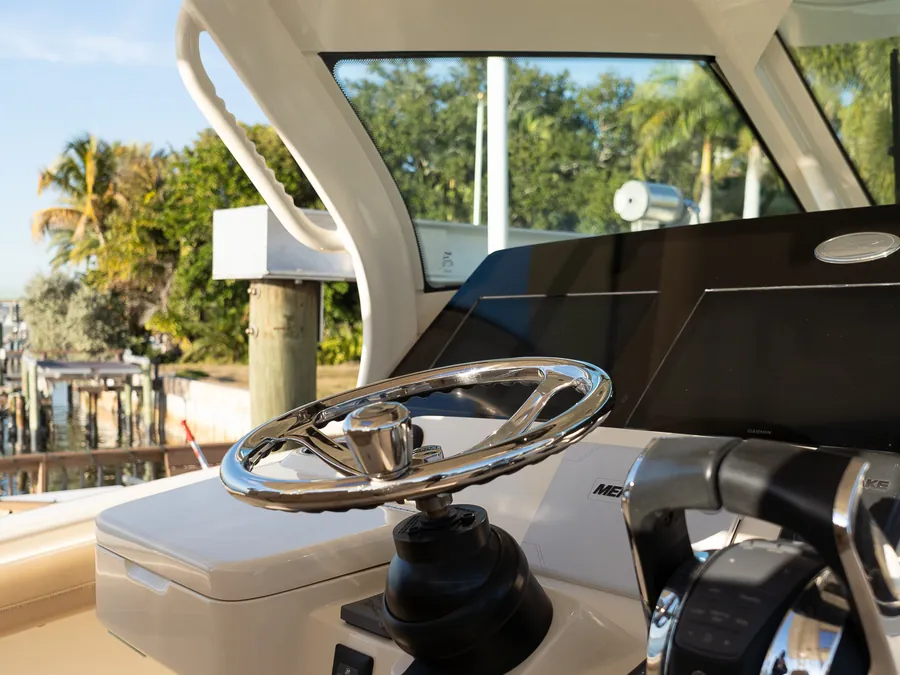
- Interior cabin and upholstery shampoo: The interior of a boat that gets regular Florida use accumulates a surprising amount of grime: salt tracked in from feet, sunscreen and sweat worked into seating, fish odors embedded in carpet or marine vinyl, mildew in corners and under cushions, and general dust and debris in every storage compartment. We shampoo marine vinyl and fabric seating using products formulated to lift stains without degrading UV inhibitors built into the vinyl. Carpet areas get hot-water extraction or agitation-and-vacuum treatment depending on material type. We also clean the dashboard, helm area, cup holders, and storage pockets that get overlooked in a basic rinse job.
- Window and windshield cleaning: Marine glass and acrylic windows accumulate hard water deposits, salt haze, and in some cases, light scratching from improper wiping. We clean all glass and acrylic surfaces with products that are safe for both materials, remove mineral deposits without abrading the surface, and finish with a water-repellent treatment that helps rain and spray bead off during use. Clear visibility from the helm isn't just a cosmetic issue; it's a practical safety consideration, especially when navigating busy waterways near Pier 60 or during afternoon chop near Clearwater Pass.
- Metal and brightwork polishing: Stainless steel rails, cleats, grab handles, and bow hardware all develop rust streaking, salt bloom, and dullness from constant saltwater exposure. We polish stainless and chrome components with appropriate metal polishes, remove rust streaks from the hull surface caused by hardware runoff, and where applicable, clean and condition teak or wood trim to restore its natural tone without leaving a greasy buildup that collects more dirt. The hardware is often the finishing detail that separates a boat that looks professionally maintained from one that just got a rinse.
While we are at it, ask about our ceramic coating protection, a lot of Clearwater Beach customers pair this with their detail to extend the results.
Our Process for Clearwater Beach Boats
We keep the process straightforward and communicate with you at every step. Here's how it works from first contact to the moment we hand the boat back to you.
Step 1: Assessment and Free Quote
Every boat we detail starts with a conversation, and usually a look at the vessel in person or through photos you send us. We ask about the boat's age, length, storage situation, when it was last professionally detailed, and anything specific you've noticed, like heavy oxidation on one side, a stubborn waterline stain, or mildew in the cabin. This assessment lets us give you an accurate quote and set honest expectations about what the detail will accomplish. A boat that has been well-maintained yearly needs a different scope of work than one that hasn't been touched in two or three Florida summers. We don't give flat-rate estimates without understanding what we're walking into, because that wouldn't be fair to you or to us. The quote is free, there's no pressure, and we'll tell you exactly what we plan to do and why.
Step 2: Prep and Surface Inspection
Once we're on-site, whether that's a marina slip, a private dock, a dry storage lot, or a trailer at your home, we do a thorough walk-around before we touch a single product to the boat. We check the gel coat under natural light, looking for oxidation patterns, scratch depth, staining locations, and any areas where the surface has been previously compounded or repaired. We also check the interior for mildew hot spots, staining patterns, and the condition of upholstery seams and carpet before we decide on product and method choices for those areas. This prep inspection is what allows us to work efficiently without making mid-job pivots, and it ensures we bring the right tools and products for the actual condition of your specific boat rather than a generic assumption.
Step 3: Detailing Treatment
We work through the boat in a logical order that prevents cross-contamination between interior and exterior work and avoids re-soiling surfaces we've already cleaned. Typically we start with the hull wash and decontamination while the boat is fully accessible, then move to polishing and wax application on the topsides and deck, and finish with interior work and metal polishing. Product dwell times are respected rather than rushed. Wax that gets buffed off too quickly doesn't bond properly. Interior shampoo that doesn't get adequate dwell time doesn't lift embedded stains the way it should. We take the time the job actually requires, which is why you get a consistent result rather than a surface-level clean that fades in two weeks. Clearwater Beach boats get detailed the same way we'd want our own boats handled.
Step 4: Final Quality Check and Walkthrough
When the work is done, we walk the entire boat again under direct light, checking every panel for high spots, streaking, or missed areas before we consider the job complete. We wipe down any product residue from trim, hardware, and glass edges. We clean up any water or product splatter from the dock or trailer. Then we walk you through what was done and what we observed about the boat's condition. If we noticed something during the job that warrants your attention, like a stress crack in the gel coat, a deteriorating hatch seal, or mildew behind a panel, we'll point it out. We're not selling you additional services; we're giving you the information a knowledgeable marine detailer would want you to have about your own vessel.
Boats and Marinas We Service Around Clearwater Beach
Clearwater Beach and the surrounding waterway system hosts a wide variety of vessels and storage configurations. We travel to your boat rather than requiring you to bring it to a fixed facility, which means we work at private residences, marina slips, dry storage yards, and boat ramp staging areas throughout the Clearwater Beach area. Here's a look at some of the specific locations and boat types we regularly service:
- Clearwater Harbor and Mandalay Channel: Boats kept in slips along the Mandalay Channel face constant tidal water exposure, splash from passing vessels, and close proximity to the marine environment that accelerates salt accumulation. We regularly service center consoles, deck boats, and mid-size cruisers in this stretch.
- Clearwater Pass and Gulf-side vessels: Boats that regularly run through Clearwater Pass and into the Gulf see the highest salinity and chop exposure in the area. These vessels often need more aggressive decontamination on the hull and more frequent wax schedules than boats that stay in protected water.
- Sand Key Bridge area: The waterways near the Sand Key Bridge are popular staging areas for fishing vessels and recreational boats heading south into the barrier island system. We service flats boats, bay boats, and offshore-capable center consoles stored and used in this corridor.
- Near Pier 60 and the Beach Causeway: Boats that anchor or moor in the Pier 60 area see heavy recreational traffic and the associated wake, spray, and foot traffic that comes with it. Interior cleaning is often a priority for these vessels because of frequent passenger use.
- Dry storage facilities in Clearwater Beach: Many boat owners in this area use drive-in dry storage, which keeps the hull out of the water but creates its own set of issues: UV exposure on the topsides, road grime on the hull bottom from trailer movement, and spider webs and debris collecting in the cockpit between uses. We work at dry storage yards regularly and are familiar with the logistical requirements.
- Private docks and residential waterfront properties: A significant number of boats in the Clearwater Beach area are kept on lifts or at private docks behind waterfront homes. We work at private properties routinely and treat each job with the same attention to your property and your boat as we would at a commercial marina.
Common vessel types in this area include 20- to 28-foot center consoles rigged for nearshore and offshore fishing, deck boats and pontoons used for family recreation on the Intracoastal, dual-console runabouts, bay boats, cuddy cabins, and express cruisers in the 30- to 40-foot range. We're comfortable with fiberglass, painted hulls, and aluminum components, and we've worked on everything from entry-level recreational boats to higher-end sportfish models.
Ready for a showroom shine?
Free quote, mobile to your dock across Tampa Bay. Same-week booking.
How Long Boat Detailing Takes in Clearwater Beach
Turnaround time depends primarily on the size of the boat and its current condition. A boat that's been maintained recently and just needs a refresh takes less time than one that's been sitting through multiple Florida summers without any professional care. Here are realistic timeframes you can plan around:
Boats under 25 feet, including most flats boats, bay boats, smaller center consoles, and personal watercraft, typically take somewhere between three and six hours for a full exterior and interior detail. If the boat is in reasonably good shape with no heavy oxidation and clean upholstery, we can often wrap up in that lower range. If there's significant oxidation on the topsides or staining in the interior that requires extra attention, we build in additional time to do the job properly rather than cut corners to hit a clock. For most boats in this size range, same-day completion is the standard expectation.
Boats in the 25- to 35-foot range, which covers a large portion of the vessels we see around Clearwater Beach, including dual-console family boats, mid-size center consoles, and smaller express cruisers, typically require somewhere between five and nine hours depending on condition. These boats have significantly more surface area on the hull and topsides, larger cockpit and cabin interiors, and more hardware and brightwork to address. If we're dealing with heavy oxidation across the full topsides or a cabin interior that hasn't been cleaned in a long time, jobs at the top of this range require a full day. We schedule these jobs accordingly and communicate our timing expectations clearly before we begin.
Boats 35 feet and larger, including larger express cruisers, sportfish models, and any vessel with a full cabin, enclosed helm, and substantial below-deck space, should be planned as a multi-phase project. These boats often take anywhere from a full day to two full days depending on the scope of work and the level of oxidation correction required on the hull. Larger boats also have more complex interiors with separate cabins, heads, and galley areas that each require individual attention. We discuss multi-day scheduling directly with owners of larger vessels to find an arrangement that works for your timeline and access requirements.
For most small and medium boats in the Clearwater Beach area, same-day turnaround is entirely realistic. We schedule efficiently, come prepared with the right products and equipment, and don't leave a job unfinished at the end of the workday. When we commit to a schedule, we stick to it.
Before and After: What to Expect
If you've never had a professional marine detail done on a Florida boat, the transformation can be genuinely surprising. Let's talk about what you'll actually see, starting with the exterior. Gel coat that looks uniformly gray or flat in the sunlight is typically oxidized, meaning the outermost molecular layer has degraded from UV exposure and dried out. After compound correction and polishing, that same panel will reflect your surroundings with a clarity and depth that frankly looks like a different material. Colors become saturated again. White hulls look crisp rather than chalky. The boat looks newer, not just cleaner. That said, the result depends heavily on the starting condition. Light oxidation corrects fully in most cases. Severe oxidation on a boat that's been neglected for several years may improve dramatically but reach a point where the gel coat itself is too thin or damaged to achieve a mirror finish without professional paint correction or respray. We tell you honestly what's achievable before we start.
On the deck and cockpit surfaces, the before-and-after difference is often most visible in the non-skid panels. Salt, sunscreen, fish blood, and general grime settle into textured non-skid and become almost invisible because they blend with the texture pattern. Once we agitate and extract that contamination, the non-skid goes from gray-brown to its actual color, whether that's white, off-white, or a color-matched deck tone. The visual pop of clean, properly colored non-skid against a freshly waxed hull is one of the first things boat owners notice. Waterline staining from biological growth, rust runoff, and tidal exposure also clears significantly after hull treatment, which makes a major visible difference on boats that have been in wet slips. The transition between the boot stripe and the hull above it becomes crisp and defined again instead of blurred by layers of grime.
Inside the boat, the change you'll notice immediately is smell. A boat that's been closed up in Florida heat with mildew in the upholstery, fish residue in the carpet, and old bilge smells drifting through the cabin has a distinctive odor that boat owners sometimes stop noticing because they're around it constantly. After a full interior shampoo and cleaning, the boat smells like a clean vessel again, not like a bait shop. Vinyl upholstery that was tacky with sunscreen buildup and stained with drink spills becomes clean to the touch and returns to close to its original tone. Carpet that looked like it needed replacement often looks dramatically improved after proper extraction cleaning. Dashboard and helm surfaces that were coated in salt haze and fingerprints become clear and readable again. The interior detail is what makes the boat genuinely pleasant to spend time on, not just nice to look at from the dock.
What Clearwater Beach Boat Owners Ask
How do I schedule a detail and what's the process to get started?
Getting started is simple. You can text or call us directly, or use the contact form on our website. We'll ask you a few questions about your boat: the length, type, storage location, when it was last professionally detailed, and any specific concerns you have. From there, we'll arrange a time to see the boat in person or review photos if you'd prefer to start that way. Once we assess the boat's condition, we provide a free quote and find a scheduling window that works for you. We serve the Clearwater Beach area and can typically get you on the calendar within a reasonable timeframe. The whole process from first contact to confirmed appointment moves quickly because we keep our scheduling straightforward.
Do you detail all types of boats, or are there sizes and types you don't work on?
We work on a wide range of vessel types and sizes. That includes center consoles, bay boats, flats boats, deck boats, pontoons, dual-console runabouts, express cruisers, cuddy cabins, sportfish boats, and aluminum fishing boats. We're comfortable with fiberglass gel coat, Awlgrip and linear polyurethane painted surfaces, and aluminum topsides. Most boats in the 15- to 45-foot range fall squarely within our standard scope of work. If you have something outside that range, like a very large sportfish or a specific hull material you're unsure about, just ask. We'll tell you directly whether we're the right fit for your vessel. We'd rather have an honest conversation upfront than take on a job we can't handle well.
How often should I get boat detailing in Clearwater Beach?
For boats kept in the Clearwater Beach area, most owners benefit from a full professional detail at least once or twice per year, with more frequent wash and wax maintenance in between. Boats in wet slips or that run through high-salinity water near Clearwater Pass regularly may want to schedule more often because the exposure is more constant and aggressive. Boats on lifts or in dry storage can sometimes go a bit longer between full details, but they still accumulate UV damage on the topsides and interior degradation from heat and humidity. A good general rule is to get a full detail at the start of your heaviest use season, keep up with rinse-downs after every outing, and schedule another full service before you go into a slower period. Boat detailing in Clearwater Beach is really a form of preventive maintenance: the more consistently you do it, the less correction work each session requires.
How does your pricing work and how do I get a quote?
We provide free quotes after a quick conversation about your boat and timeline. We don't publish flat-rate pricing because the scope of work varies significantly between a well-maintained 22-foot bay boat and a neglected 38-foot cruiser with heavy oxidation and a cabin that hasn't been cleaned in two seasons. The variables that affect the quote include the boat's length, overall condition, storage type, what services you're requesting, and any specific problem areas that need extra attention. Once we understand those factors, we give you a clear, itemized picture of what we plan to do and what it will cost. There are no surprise add-ons after the fact. Contact us to start that conversation and get your free quote.
Do you work at private docks, or do I need to bring my boat somewhere?
We come to your boat. We work at private docks, residential waterfront properties, marina slips, dry storage facilities, and boat ramp staging areas throughout the Clearwater Beach area. You don't need to trailer the boat anywhere or arrange to have it moved to a fixed location. If your boat lives on a lift behind your home on one of the canals near Clearwater Beach, we'll work with you to schedule a time when the boat is lowered and accessible. If it's in a slip at a marina, we'll coordinate access with you and observe any marina-specific requirements for contractors. We bring our own equipment and connect to the water and power at your dock, so all you need to provide is access to water and power. The goal is to make the whole experience as easy as possible for you.
Service Areas Nearby
Sunrise Marine Detailing LLC serves the full Clearwater Beach area and also covers the surrounding waterway communities throughout Pinellas County and the greater Tampa Bay region. We also detail boats kept in Clearwater, including the mainland marina facilities along the Clearwater Harbor shoreline just east of the barrier island. We serve Island Estates, the residential waterfront community connected to Clearwater Beach by the causeway, where a significant number of private docks and lifts keep vessels of all sizes. Dunedin is another regular service area for us, with its charming waterfront and the Dunedin Causeway corridor that connects to Honeymoon Island and Caladesi Island. We cover Safety Harbor on the eastern side of Old Tampa Bay, as well as Largo and Seminole for boat owners on the mid-county waterways. Further south along the barrier island chain, we serve Indian Rocks Beach and Indian Shores, where boats see similar Gulf exposure conditions to Clearwater Beach and benefit from the same detail approach. Across the bay, we cover parts of the St. Petersburg and South Pasadena waterfront communities as well. If you're not sure whether your location falls within our range, just ask. We cover a wide area and we're flexible about travel for the right job. Our goal is to be the detailer that Pinellas County boat owners come back to season after season, not just once, and that means being accessible across the communities that make up this boating region.
We also serve nearby areas, see Palmetto or Treasure Island for the same boat detailing work.
Get a Free Quote
Ready to get your boat looking the way it should? Sunrise Marine Detailing LLC is here to help boat owners in Clearwater Beach and across the surrounding waterways, from the Mandalay Channel to Clearwater Pass and every dock in between. Text us, call us, or use the contact form below to start the conversation. Tell us about your boat, where it's kept, and what you're hoping to accomplish, and we'll put together a free, no-pressure quote that fits your vessel and your schedule. We look forward to earning your trust and taking great care of your boat. Call (727) 297-8866 schedule a free quote, or see what other Clearwater Beach owners say.