 Sunrise Marine
If you're searching for boat ceramic coating in Clearwater Beach, you already know what this water does to a hull. The combination of direct Gulf sun, heavy salt spray off Clearwater Pass, and the constant wash from boat traffic near Pier 60 creates one of the harshest environments a gel coat can face anywhere in Florida. UV oxidation sets in fast, salt mineral deposits build up on every surface between trips, and if your boat sits on a lift or at a wet slip in the Mandalay Channel, that cycle repeats every single week. Our marine-grade ceramic coating bonds directly to your gel coat, seals out salt, blocks UV rays, and keeps your boat looking the way it should for 18 to 24 months at a time. If you're ready to stop polishing and start protecting, reach out to Sunrise Marine Detailing LLC today for a free, no-pressure quote. For the full picture of how this fits with our marine ceramic coating, or to see how we handle a nearby spot like Clearwater Beach, keep reading.
Why Clearwater Beach Boats Need Boat Ceramic Coating
Clearwater Beach sits right at the intersection of the Gulf of Mexico and Tampa Bay, which means the water around here is not calm, sheltered bay water. It is open-saltwater, high-UV, high-salinity water that rolls in from the Gulf and pushes through narrow channels like Clearwater Pass every single day. Boats docked near the Sand Key Bridge or out on the barrier island face direct western exposure to afternoon sun, which is the most intense UV window of the day in Florida. That sun hits your hull, your deck, your rubrails, and your non-skid at angles that would be considered extreme even by Miami standards. The gel coat on most fiberglass boats is not designed to hold up to that kind of exposure indefinitely, and once oxidation sets in, you start losing that deep gloss from the surface layer down. A marine ceramic coating creates a sacrificial layer on top of the gel coat that takes the hit instead of your boat's finish.
The salt situation in this area is also worth understanding, because it's different from what boat owners experience on freshwater lakes or even some parts of Tampa Bay proper. When you're running out through Clearwater Pass toward the Gulf, your hull picks up salt spray from chop, your topside picks up salt mist from wind, and when the water evaporates, it leaves behind mineral deposits that are mildly acidic and clingy. If you tie up near the Clearwater Marine Aquarium area or keep your boat at a wet slip in the Mandalay Channel, that salt is sitting on every surface between every trip. Without a coating that actively repels water, those deposits bond into the pores of your gel coat and start to etch the surface over time. Ceramic coating's hydrophobic properties cause water to bead and sheet off the hull rather than sitting and evaporating, which dramatically reduces the rate at which salt builds up and causes damage.
The boats around Clearwater Beach also tend to live hard lives. This is not a marina full of weekend day-sailors who motor out once a month. You have center console fishing boats running out to the nearshore reefs before sunrise. You have pontoon boats full of families crossing to Caladesi Island every weekend. You have larger offshore cruisers sitting on lifts or in wet slips, getting hit by weather systems moving up from the south and by the wakes from the commercial fishing boats and dive charters that use this stretch of coastline heavily. Common boat sizes here range from 18-foot center consoles up through 35 to 40-foot offshore cruisers, and ceramic coating makes sense across all of those categories. Whether your boat spends most of its time on a lift where the hull dries and bakes in the sun or in a wet slip where growth and salt accumulate on the waterline, the coating provides real, measurable protection. Most of our Clearwater Beach customers come to us after a Florida summer strips the gloss off a boat they thought was in decent shape, and they want a smarter solution than buffing and waxing every few months.
What's Included in Our Boat Ceramic Coating Service
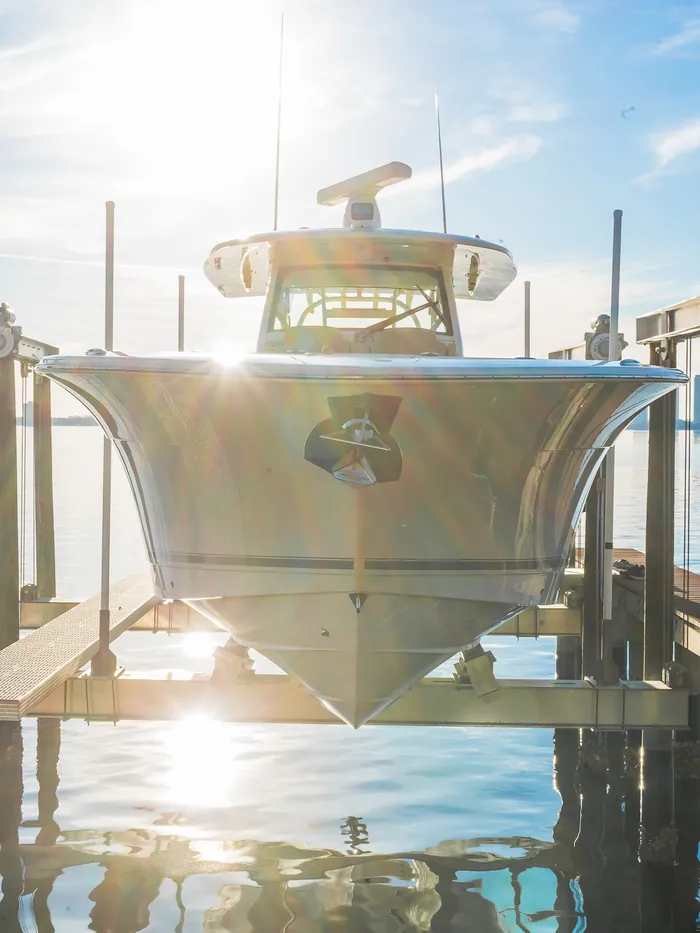
- Full hull wash and salt decontamination: Before any coating touches your boat, we do a thorough two-step wash process that starts with a dedicated marine iron remover to pull rust particles and mineral deposits out of the gel coat surface, followed by a pH-balanced marine soap that lifts salt, fish blood, bait residue, and general grime without stripping any existing protection. This step is not optional, and it's not a quick rinse. A properly decontaminated hull is the foundation that makes the ceramic coating bond correctly and last the full 18 to 24 months. Boats coming in from Clearwater Beach and the surrounding Gulf waterways almost always carry a heavier-than-average salt load, so we spend extra time on the waterline and the lower hull sections where mineral deposits tend to concentrate.
- Clay bar surface prep and paint correction: Once the hull is clean, we use a marine-grade clay bar across all coated surfaces to remove any bonded contaminants, light oxidation particles, and surface-level deposits that the wash step didn't fully lift. For boats with light to moderate oxidation, we follow the clay bar with a light machine polish to restore clarity to the gel coat before the ceramic layer goes on. This matters because ceramic coating is a sealer, not a filler. If you apply it over a dull or hazy surface, it seals in the dullness. Our prep process makes sure the surface underneath is as clean, smooth, and glossy as it can be so the ceramic has the best possible foundation to bond to and the final result has real depth and shine.
- Marine-grade ceramic coating application: We apply a professional-grade, marine-specific ceramic coating product that is formulated to handle the specific stressors of saltwater environments, including higher humidity during curing, UV intensity, and repeated saltwater contact. The coating bonds at a molecular level to the gel coat surface and forms a semi-permanent protective layer that is significantly harder and more chemically resistant than wax or sealant. We apply it in controlled sections so that each panel gets even coverage and full bonding time before we move on. Most boats get two layers across the hull sides, deck, non-skid, and above-waterline surfaces, depending on the condition and porosity of the gel coat.
- Non-skid deck treatment: The non-skid surfaces on most fiberglass boats are one of the first places UV damage and salt staining show up visibly, because the textured pattern traps salt crystals and debris and is harder to clean than a smooth hull panel. We treat non-skid with a formulation that penetrates into the texture pattern rather than sitting on top of it, which gives you the protective benefits without making the surface slippery or altering the way it feels underfoot. After coating, non-skid areas rinse much more easily and don't hold the gray, chalky residue that typically builds up after a summer of saltwater use in an area like Clearwater Beach.
- Brightwork and trim detail: Stainless steel rails, cleats, hinges, and other hardware pick up water spots and salt haze faster than almost any other surface on the boat. We clean and treat brightwork as part of the service to remove oxidation and tarnish from your stainless and aluminum fittings, and we apply a protective coating to slow the return of water spotting and corrosion. Teak accents and wood trim get inspected and treated appropriately depending on condition. When we're done, the brightwork should match the level of cleanliness and protection that the rest of the boat receives, rather than standing out as the one spot that was missed.
- Windshield and glass treatment: We apply a hydrophobic glass treatment to windshields, portlights, and any other glass or polycarbonate surfaces on the boat. This causes water and salt spray to sheet off the glass when underway rather than beading on it and reducing visibility. In the Gulf chop you get running out of Clearwater Pass, forward visibility at speed can be genuinely affected by a dirty or water-spotted windshield, and the hydrophobic treatment keeps things cleaner longer between trips. We also remove existing water spot mineral deposits from the glass before applying the treatment so you're starting with optically clear surfaces.
- Final inspection and customer walkthrough: Once the coating has cured and we've gone over every section of the boat, we do a full walk-around inspection in good lighting to catch any missed spots, streaks, or areas where the coating didn't level evenly. We then walk you through the finished result, explain what the coating will and won't do over time, and give you specific advice on maintenance washes and what products are safe to use on coated surfaces. You leave knowing exactly what you have, how to take care of it, and when to plan for the next treatment cycle.
While we are at it, ask about our oxidation removal before coating, a lot of Clearwater Beach customers pair this with their detail to extend the results.
Our Process for Clearwater Beach Boats
Step 1: Initial Assessment and Free Quote
Every job starts with a conversation, not a generic price sheet. When you contact Sunrise Marine Detailing LLC, we'll ask you about your boat's length, beam, hull material, current condition, and where you keep it. Boats kept in wet slips near the Mandalay Channel or on lifts out near Sand Key often have very different surface conditions than boats trailered and stored inland, and we want to understand exactly what we're working with before we give you an accurate quote. We may ask for a few photos if you can send them, or we can schedule a quick visual inspection at your dock or marina. This step costs you nothing and takes very little time, and it makes sure there are no surprises when we show up to do the work.
Step 2: Surface Preparation and Decontamination
Preparation is genuinely where the quality of a ceramic coating job is determined. A coating applied to a surface that still has salt deposits, oxidation particles, or wax residue from a previous product will not bond correctly, and it will not last the way it should. We arrive at your location with all the equipment needed to do a full decontamination wash, clay bar prep, and correction polish before the ceramic product ever comes out of the bag. For boats in Clearwater Beach that have been running in Gulf water through the summer, this stage often takes longer than it does for boats in more sheltered water, because the salt load and UV exposure here are genuinely more intense. We do not rush this step.
Step 3: Ceramic Coating Application and Cure
After prep, we move to coating application. We work in shaded or covered conditions wherever possible to control the application environment, because temperature, humidity, and direct sunlight all affect how a ceramic coating levels and bonds during the first stage of curing. We apply the coating in manageable sections, working panel by panel and checking our work as we go. The initial flash cure happens within minutes of application, but the full chemical bond continues to develop over 24 to 48 hours after we're done. We'll give you specific instructions about keeping the boat dry and out of rain during that initial curing window, and we'll let you know when it's safe to take it out for its first post-coating run.
Step 4: Quality Control and Final Walkthrough
Before we consider the job complete, we go through a structured quality check that covers every surface we treated. We look for high spots, low spots, uneven coverage, or any areas where the coating didn't level correctly, and we address those while we're still on-site. Then we do the customer walkthrough. We want you to see every section of the boat in good light so you can ask questions and understand what you're looking at. We'll explain how the coating changes the way your boat feels when you run a hand over the hull, what to expect the first time salt spray hits a coated surface, and how to do a maintenance wash at home without degrading the coating. This walkthrough is part of what you're paying for, not an afterthought.
Boats and Marinas We Service Around Clearwater Beach
Clearwater Beach and the surrounding barrier islands are home to one of the most active recreational boating communities in the entire Tampa Bay region. We work regularly with boat owners who keep their vessels at marinas, private docks, and on lifts throughout this stretch of the Gulf coast. Whether your boat is sitting at a wet slip within sight of Pier 60 or lifted out on a private dock along the Mandalay Channel, we come to you. You don't have to trailer your boat anywhere or arrange a haul-out for a standard ceramic coating service. We bring everything we need to your location.
The waterways and areas we regularly work in around Clearwater Beach include a wide range of storage situations and boat types, and we're familiar with the logistics of working in each of them. Understanding the local geography, the tidal schedule, and the access limitations at different docks and marinas is part of what makes us effective at scheduling and completing jobs without disrupting your boating season. Here's a breakdown of the specific areas and boat categories we work with most frequently:
- Clearwater Pass and Gulf-facing docks: Boats kept along Clearwater Pass face the most direct Gulf exposure of any location in the area. These vessels pick up the heaviest salt load and take the hardest UV hit, which makes them ideal candidates for ceramic coating. We work at private docks and marina slips throughout this corridor regularly.
- Mandalay Channel slips and marinas: The Mandalay Channel runs through the heart of the Clearwater Beach boating district, and there are numerous marinas and private slips along its length. Boats in wet slips here are exposed to constant saltwater contact at the waterline and benefit significantly from the hydrophobic properties of a ceramic hull coating.
- Sand Key area lifts and private docks: The residential and marina communities around Sand Key and the Sand Key Bridge have a high concentration of lift-stored boats, often in the 24 to 36-foot range. Lift storage keeps the hull out of the water, but it also exposes the entire hull to direct sunlight and air-dried salt, which creates its own unique oxidation pattern that ceramic coating addresses effectively.
- Pier 60 and downtown Clearwater Beach marinas: The public and semi-public marina facilities near Pier 60 see a mix of fishing boats, pontoons, and cruisers. We service boats kept in this area and are familiar with the access and parking logistics involved in working at waterfront locations with higher foot traffic.
- Center console fishing boats: From 18-foot bay boats to 32-foot offshore center consoles, these are among the most common vessels in the Clearwater Beach fleet. They take a beating running offshore and deserve a coating that can handle the exposure. We've worked on more center consoles in this zip code than any other boat category.
- Pontoon and deck boats: Pontoon boats and deck boats are extremely popular in the Clearwater Beach area for family use and rental fleets. Their large flat deck surfaces and aluminum pontoons have specific coating needs, and we customize our process accordingly.
Ready for a showroom shine?
Free quote, mobile to your dock across Tampa Bay. Same-week booking.
How Long Boat Ceramic Coating Takes in Clearwater Beach
One of the most common questions we get from boat owners in Clearwater Beach is how long the whole process takes from start to finish. The honest answer is that it depends primarily on the size of the boat, the current condition of the gel coat, and whether the boat needs correction work before the coating goes on. Here's a realistic breakdown by boat size category so you can plan your schedule accordingly.
For boats under 25 feet, including smaller center consoles, bay boats, deck boats, and smaller pontoons, the full service from decontamination wash through final walkthrough typically takes between four and seven hours. Many of these jobs can be completed in a single day, and in some cases, a boat dropped off or made accessible in the morning is ready for pickup or inspection by late afternoon. If the gel coat is in good condition with only light oxidation and normal salt buildup, prep time is faster, which keeps the total appointment time on the shorter end of that range.
For boats in the 25 to 35-foot range, which covers a large portion of the offshore fishing boats, express cruisers, and larger pontoon rigs common to the Clearwater Beach area, plan on a full day of work, typically in the range of seven to ten hours. Boats in this size class have significantly more surface area to decontaminate, prep, and coat, and the waterline area on a 30-foot hull is substantial. If there is moderate oxidation that requires machine polishing before the ceramic layer goes on, add another one to two hours to the estimate. Most of these jobs are completed in a single appointment, but we schedule them with full-day access to the boat to avoid rushing any stage of the process.
Boats over 35 feet, including larger offshore cruisers, sportfishers, and big pontoon or catamaran style vessels, typically require two days or a full long day depending on the specifics. The prep stage alone on a 40-foot hull is a substantial undertaking, and we don't compress the schedule in a way that would compromise the quality of the coating application. For larger vessels, we discuss the schedule in detail during the initial quote process so the boat owner can plan access and availability accordingly.
It's also worth noting that the Clearwater Beach area's afternoon weather patterns matter when we're scheduling. Summer thunderstorms can affect outdoor work windows, and we account for that when we plan the day. We try to schedule so that the most sensitive stages, especially the final coating application and the initial flash cure, happen during the more stable morning hours rather than the afternoon storm window that's common in Florida's wet season.
Before and After: What to Expect
Most boat owners in the Clearwater Beach area who come to us for ceramic coating are dealing with one of a few common situations. Some have a boat that was glossy and clean when it was new but has gradually gone chalky and flat over one or two Florida summers. Others have a boat they've been waxing themselves twice a year and are tired of the wax fading within a few months. And some are buying a used boat that was kept at a Gulf-side marina for several years and needs real restoration work before it can be properly protected. In all of these cases, the before-and-after transformation is real and visible, but the specifics are worth understanding so you have accurate expectations going in.
The most dramatic change most boat owners notice is in the hull sides. A gel coat that has gone hazy and chalky from UV oxidation has a flat, dusty look to it, almost like paint that has been sanded with fine sandpaper. After our prep and correction process removes the oxidized layer and the ceramic coating goes on over the freshly revealed surface underneath, the depth and gloss come back in a way that surprises a lot of people who have been looking at the dull version for years. The color gets richer, the reflections get sharper, and the hull looks like it's wet even when it's dry. That is the hydrophobic ceramic surface doing exactly what it's designed to do, and it's one of the most satisfying things to show a customer during the final walkthrough.
The non-skid deck areas show a different kind of transformation. They don't come out glossy, because they're not supposed to. What you'll notice on the deck is that the chalky gray haze that builds up in non-skid texture from salt and UV exposure lifts away, and the original molded-in color of the deck comes back. If your boat's deck was originally a cream or off-white color, the non-skid will look that color again instead of the flat, faded gray that a season of Gulf saltwater exposure produces. It rinses cleaner between trips, it doesn't hold salt crystals in the texture the way an unprotected surface does, and it generally looks better maintained even when it's just had a quick freshwater rinse after a day on the water. The brightwork transformation is also satisfying: stainless steel that was cloudy and lightly spotted comes back to a clean, reflective finish that holds up noticeably better to salt air between detail sessions.
What the coating doesn't do is worth mentioning too. It does not fill scratches or gouges in the gel coat. It does not fix deep UV damage that has gone below the surface layer. It does not eliminate the need to rinse your boat after saltwater use. It is a protective layer, not a magic fix. The best results come from boats that have been properly prepped before the coating goes on and properly maintained afterward. We explain all of this during the final walkthrough so you have a clear picture of what you're working with and what to do next time you notice a water spot or a bit of salt residue after a run out through Clearwater Pass.
What Clearwater Beach Boat Owners Ask
How do I schedule a boat ceramic coating appointment in Clearwater Beach?
Scheduling starts with a quick conversation about your boat and what you're working with. You can reach us by phone, text, or through the contact form on this page. We'll ask you about the boat's size, current condition, where it's kept, and what your timeline looks like. From there, we put together a free quote and find a date that works for both of us. We come to you at your marina, private dock, or storage facility, so there's no need to arrange a haul-out or trailer the boat anywhere. Most customers in the Clearwater Beach area are surprised by how straightforward the scheduling process is. Just reach out and we'll take it from there.
Does ceramic coating work on all boat types and hull materials?
Marine ceramic coating works well on fiberglass gel coat, painted aluminum, and gelcoated composite hulls, which covers the large majority of recreational boats in the Clearwater Beach area. Center consoles, pontoon boats, express cruisers, bay boats, deck boats, and offshore sportfishers are all candidates. Boats with antifouling bottom paint on the hull below the waterline are handled differently, since bottom paint is not a surface you'd coat with a ceramic product. We focus the coating on the above-waterline hull sides, deck, and topside surfaces. If you have questions about whether your specific boat is a good candidate, that's exactly the kind of thing we talk through during the initial quote call.
How often should I get boat ceramic coating in Clearwater Beach, FL?
For boats kept in the Clearwater Beach area, we recommend planning on a ceramic coating treatment every 18 to 24 months. The Gulf saltwater environment and the intense UV exposure from Florida's sun are harder on coatings than more sheltered freshwater environments, so the upper end of that range is realistic for boats that stay in the water or on lifts year-round. Boats that are trailered and stored inside during winter months may get closer to the full 24-month window before they need refreshing. The right answer really depends on how hard you use the boat, how often it gets rinsed, and how much UV exposure it gets in storage. When we do the initial assessment, we can give you a specific recommendation based on your situation.
How does pricing work and how do I get a quote?
We provide free quotes after a quick conversation about your boat and timeline. There's no standard price list because the cost depends on the length of the boat, the beam, the number of surfaces being coated, and the amount of prep work required based on the current condition of the gel coat. A boat that needs moderate correction work before the coating goes on takes more time and costs more than a boat that's been well maintained and just needs decontamination and coating. That said, we're straightforward about what goes into the quote and why, so you understand exactly what you're paying for. Reach out to us and we'll get you numbers you can actually plan around.
Do you work at private docks, or do I need to bring the boat to a facility?
We work at private docks, residential waterfront properties, marinas, and storage facilities throughout the Clearwater Beach area and the surrounding communities. If your boat lives on a lift at your seawall or in a slip at a marina in the Mandalay Channel, we come to you. We bring all the equipment needed to complete the full service on-site, and we connect to the water and power at your dock. The only thing we need from you is access to the boat and a water source and enough space to move around it safely. Working at your location is often more convenient for the boat owner and makes scheduling easier, so it's how we prefer to operate in most cases.
Service Areas Nearby
While a significant portion of our work is in Clearwater Beach and along the barrier island waterways, Sunrise Marine Detailing LLC serves boat owners throughout the broader Pinellas County and Tampa Bay area. If your boat is kept just outside Clearwater Beach, there's a very good chance we're already working in your neighborhood and can work yours into our schedule without any issue. Proximity to the Gulf and Tampa Bay waterways is the common thread across all of our service areas, and the conditions that make ceramic coating valuable in Clearwater Beach apply equally to the surrounding communities.
We also serve nearby areas, see Palm Harbor or Palmetto for the same boat ceramic coating work.
We also detail boats kept in Dunedin, where the Dunedin Marina and the waterways connecting to Caladesi Island are home to a wide range of sailboats, fishing boats, and cruisers that face the same Gulf saltwater and UV exposure challenges as Clearwater Beach vessels. Heading south along the Pinellas peninsula, we serve customers in Indian Rocks Beach, Indian Shores, and Redington Beach, where a high concentration of private docks and smaller marinas line the Intracoastal Waterway. We work regularly in St. Pete Beach and Treasure Island, where the barrier island boat communities have similar Gulf-facing exposure and many of the same boat size profiles we see in Clearwater Beach. Further south, we serve the St. Petersburg waterfront along Tampa Bay, including customers at the downtown St. Pete marinas and the residential canal communities in that area. Heading across the Bay, we also work with customers in the Safety Harbor, Oldsmar, and Tampa waterfront areas. If you're within the greater Tampa Bay boating region and looking for a ceramic coating service that understands how Gulf and Bay saltwater environments work, we're worth a conversation regardless of your specific zip code.
Get a Free Quote
If your boat is kept anywhere along the Clearwater Beach waterways, including the Mandalay Channel, Clearwater Pass, the waters near Pier 60, or the communities along Sand Key, we'd like to hear from you. Sunrise Marine Detailing LLC makes getting a quote simple. Text us, call us, or fill out the contact form below with a few details about your boat and we'll get back to you quickly with a clear, honest quote and a realistic timeline. There's no obligation and no sales pressure. Just two people who care about boats talking through what yours needs and whether boat ceramic coating in Clearwater Beach is the right next step for your vessel this season. Call (727) 297-8866 schedule a free quote, or see what other Clearwater Beach owners say.