 Sunrise Marine
If you're searching for boat ceramic coating in Safety Harbor, you already know what the water and sun around here do to a hull. Old Tampa Bay is a saltwater environment, and boats kept at Safety Harbor Marina or tied up along the Old Tampa Bay shoreline face constant exposure to brine, UV radiation, and the kind of relentless Florida heat that turns a glossy gel coat chalky in a single season. Sunrise Marine Detailing LLC applies a marine-grade ceramic coating that bonds directly to your gel coat, seals out salt and oxidation, and keeps your boat looking clean and protected for up to two years. Most boat owners in this area only need this service done every 18 to 24 months, which makes it one of the smartest investments you can make for your vessel. If your hull is starting to show that dull, faded look, or if you want to get ahead of the damage before it sets in deep, reach out today for a free quote and we will walk you through exactly what your boat needs. For the full picture of how this fits with our marine ceramic coating, or to see how we handle a nearby spot like Safety Harbor, keep reading.
Why Safety Harbor Boats Need Boat Ceramic Coating
Safety Harbor sits right at the northern tip of Old Tampa Bay, and that geography creates a specific set of conditions that are genuinely rough on boat surfaces. The bay here is shallow and warm, which means the water temperature stays elevated for most of the year. Warm, shallow saltwater evaporates faster off surfaces, leaving behind salt crystals that act like fine-grit sandpaper every time you wipe down your hull without rinsing properly. Boats that sit at the dock overnight absorb this salt residue into any microscopic pore or surface scratch in the gel coat. Over time, those pores trap oxidation and UV damage that no amount of waxing can fully reverse. Ceramic coating fills and seals those surface imperfections before they become deep-set problems. If you've watched your gel coat go from glossy white to a chalky, yellowed finish over a couple of seasons at the marina, you've seen this process play out firsthand.
The sun exposure around Safety Harbor is its own category of challenge. Boats moored at Safety Harbor Marina or launched from the boat ramp near Philippe Park spend hours under direct Florida sun, often without the benefit of a covered slip. UV radiation degrades the resin in gel coat, causing oxidation that starts as a slight dullness and progresses to a rough, chalky texture that feels like dry chalk under your hand. A quality marine ceramic coating creates a sacrificial UV barrier on top of the gel coat, so the sun is degrading the ceramic layer rather than your actual fiberglass. That distinction matters enormously when you think about the cost of a professional color restoration on an oxidized hull versus the cost of a ceramic treatment that prevents the oxidation from getting that far. Boats in this area that skip regular protection end up needing compounding, polishing, and sometimes even professional gelcoat restoration just to get back to baseline.
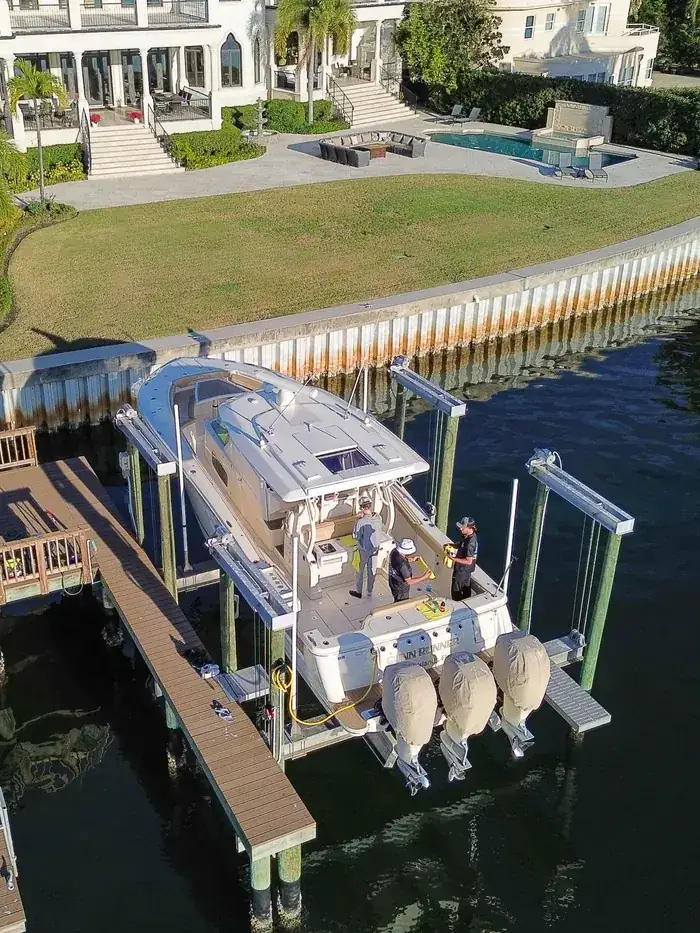
Storage and dock conditions around Safety Harbor also vary widely, and each setup comes with its own surface challenges. Some boats are kept on lifts, which helps reduce waterline buildup but still leaves the hull exposed to salt air and sun during the day. Boats that sit in the water full-time develop more aggressive waterline staining and are more likely to show oxidation on the hull sides from the constant salt splash. Smaller center consoles and flats boats, which are extremely common in this area because of the excellent shallow-water fishing throughout Old Tampa Bay and around the Safety Harbor Pier, often get trailered between trips and spend time sitting in driveways under the open sky. Whether your boat lives on a lift, at a wet slip, or on a trailer in your driveway, ceramic coating provides the same protective benefits. The coating does not care how your boat is stored. It cures to a semi-permanent bond with the gel coat surface and simply does its job regardless of what the environment throws at it.
What's Included in Our Boat Ceramic Coating Service
- Full hull wash and salt decontamination: Before anything else goes on the boat, we run a thorough two-stage wash that starts with a dedicated salt and mineral remover to pull out the salt crystals embedded in the gel coat surface. We follow that with a pH-balanced marine soap rinse that lifts oxidation residue, fish slime, and dock grime without stripping any remaining protection. This step alone makes a visible difference and sets a clean foundation for everything that follows. Skipping a proper decontamination wash is the single most common reason ceramic coatings fail to bond properly, so we do not rush it.
- Clay bar treatment and surface decontamination: After the wash, we clay bar the entire hull and topsides to remove bonded contaminants that a wash alone cannot lift. Salt deposits, industrial fallout from being near busy waterways, and microscopic debris from marina environments all bond to gel coat and create surface texture that blocks a clean ceramic bond. The clay bar stage leaves the surface feeling smooth and clean, almost like factory-fresh fiberglass, and it is a critical step that professional ceramic application requires. Most standard boat washes and waxes skip this step entirely.
- Paint correction and oxidation removal: If your gel coat shows light to moderate oxidation, we perform a machine polish pass to correct the surface before ceramic is applied. This step removes the chalky, dull layer of degraded resin and brings your gel coat back to the gloss and color depth it had when the boat was newer. We use dual-action and rotary polishers with marine-specific compounds matched to the hardness and condition of your specific gel coat. The quality of your final ceramic finish depends directly on the quality of the surface underneath, so this step is not optional when oxidation is present.
- Marine-grade ceramic coating application: We apply a professional-grade, marine-formulated ceramic coating to your hull, topsides, and any other surfaces specified. Marine ceramic formulas are specifically engineered to handle the expansion and contraction that fiberglass and gel coat experience with water temperature changes and UV exposure. The coating is applied in thin, controlled layers and leveled by hand, section by section, to ensure full, even coverage without high spots or streaking. Once cured, this layer bonds to the gel coat at a molecular level and creates a surface that water, salt, and UV cannot penetrate.
- Non-skid surface treatment: The non-skid surfaces on your deck and cockpit floor are some of the most neglected areas on any boat, and they accumulate salt, sunscreen, fish blood, and general grime deep in their textured pattern. We treat non-skid surfaces with a dedicated ceramic-compatible formula designed to penetrate the texture without making the surface slippery. This keeps non-skid areas cleaner between trips and makes future rinse-downs dramatically easier. Non-skid that has been ceramic treated releases salt and debris with a simple fresh-water rinse instead of requiring scrubbing and detergent every time.
- Trim, rub rail, and hardware protection: We extend ceramic protection to your rub rails, vinyl trim, and stainless or aluminum hardware where applicable. These surfaces are often the first to show neglect, with rub rails fading from bright white to dull gray and hardware developing salt haze or rust staining from exposure. Ceramic protection on these surfaces dramatically slows that fading and oxidation process and keeps the whole boat looking cohesive and well-maintained rather than having a gleaming hull next to neglected trim.
- Final inspection and customer walkthrough: When the coating has cured, we do a thorough visual inspection of the entire boat under different light angles to confirm even coverage and catch any areas that need a touch-up pass. We then walk you through the finished boat and explain the basic care routine that will maximize the life of your ceramic coating. The maintenance routine is simple, mostly just rinsing with fresh water after each use, and we want to make sure every customer understands it before we pack up.
While we are at it, ask about our oxidation removal before coating, a lot of Safety Harbor customers pair this with their detail to extend the results.
Our Process for Safety Harbor Boats
Step 1: Initial Assessment and Free Quote
Every job starts with a conversation about your boat. We want to know the length, beam, hull type, current condition of the gel coat, and how and where the boat is stored. This information lets us give you an accurate quote and an honest timeline before any work begins. For boats kept at Safety Harbor Marina or on the water anywhere along the Old Tampa Bay shoreline, we also factor in waterline staining and saltwater exposure history, because those boats typically need more thorough decontamination work before ceramic can go down properly. We do not charge for quotes, and we do not pressure you to book anything on the first call. Our goal is to make sure you understand exactly what the job involves and what results are realistic for your boat's current condition. Honest assessments upfront save everyone time and frustration later.
Step 2: Surface Preparation
Surface preparation is the phase that most determines whether a ceramic coating job lasts 18 months or 18 weeks. We begin with the multi-stage wash and decontamination process described above, followed by clay bar treatment of all surfaces to be coated. For boats with light oxidation, a single polish pass brings the gel coat back to gloss. Boats with moderate to heavy oxidation require more aggressive compounding followed by a finishing polish to remove compounding marks before the ceramic goes on. We work methodically from bow to stern, doing one section at a time, and we inspect each panel under lighting to confirm it is clean, smooth, and fully decontaminated before we move to the next. This step takes longer than the coating application itself, which surprises some customers, but it is where the real work happens. Rushing preparation is how you end up with a coating that looks great for a few months and then starts peeling or hazing because it bonded to a contaminated surface.
Step 3: Ceramic Coating Application
Once the surface is fully prepped, we begin the ceramic coating application. We work in sections, applying the coating with applicator pads and leveling it with clean microfiber towels before it begins to flash. Ceramic coating has a short working window once it contacts the surface, so this step requires focus and consistent technique to avoid high spots, smearing, or uneven coverage. We apply multiple layers where needed to build the coating thickness on areas that take the most abuse, including the waterline and the leading edges of the hull. Temperature and humidity matter during application, which is why we schedule jobs at times that give us the best environmental conditions for the coating to flash and cure correctly. In the Florida summer heat, we often start early in the morning to take advantage of cooler temperatures before midday.
Step 4: Cure Inspection and Customer Handoff
After the coating has had sufficient time to cure, we perform a full inspection of the boat. We check coverage under direct sunlight and from low angles, which reveal any inconsistencies in the coating layer that direct overhead light might miss. Any areas that need a touch-up pass get addressed at this stage before we call the job complete. When we are satisfied with the result, we do the customer walkthrough we described earlier. We show you the finished surfaces, explain how the coating will continue to harden and perform over the next several days as it fully cures, and give you a simple rinse-and-maintain routine. We also discuss the ideal next service interval for your boat based on how it is stored and how frequently it is used, so you have a clear picture of what your boat will need going forward.
Boats and Marinas We Service Around Safety Harbor
Safety Harbor and the surrounding waterways are home to a wide variety of boats, from small aluminum-hull flats skiffs and center consoles used for shallow-water fishing in Old Tampa Bay, to larger offshore fishing boats and cruising vessels that transit regularly between the bay and the Gulf. We service all of these vessel types and work at the locations where they are kept. The Safety Harbor area has a strong recreational boating community, and we have worked on boats that fish the flats near Philippe Park, vessels kept at Safety Harbor Marina, and boats that run out past the Safety Harbor Pier on weekend mornings headed for deeper water. Below is a list of the specific areas and vessel types we service regularly around Safety Harbor.
- Safety Harbor Marina: The main marina in town, where we regularly service wet-slip and dry-storage boats ranging from 18-foot center consoles to 35-foot cruisers. Salt buildup and UV oxidation are both common at this location due to the open exposure along the bayfront.
- Old Tampa Bay shoreline properties: Many Safety Harbor residents keep boats on private docks along the Old Tampa Bay shoreline. We travel to private docks and perform full ceramic coating services on-site, bringing all equipment to your location.
- Philippe Park boat launch area: Boats trailered to and from the ramp at Philippe Park are some of the most common vessels we see. Trailerable center consoles, flats boats, and bay boats in the 17 to 26 foot range make up a big portion of the ceramic coating work we do in this area.
- Safety Harbor Pier and surrounding shoreline: The area around the Safety Harbor Pier sees heavy small-boat traffic, and many of the boats that fish those waters are stored nearby. We work with owners whose boats live in this part of the bay corridor.
- Pontoon and deck boats on residential canals: Safety Harbor and nearby Oldsmar have residential canal neighborhoods where pontoon boats and deck boats are a common sight. These boats benefit enormously from ceramic coating because their large flat deck surfaces are extremely vulnerable to UV damage and the fading that comes with years of direct Florida sun exposure.
- Offshore and near-shore fishing vessels: Larger offshore boats in the 30 to 45 foot range that are kept in the area and make regular runs into the Gulf receive our full ceramic service including hull, topsides, hardtop surfaces, and non-skid treatment. These larger vessels represent some of our most comprehensive single-boat jobs.
Ready for a showroom shine?
Free quote, mobile to your dock across Tampa Bay. Same-week booking.
How Long Boat Ceramic Coating Takes in Safety Harbor
One of the most common questions we hear from boat owners in Safety Harbor is how long the whole process will take. The honest answer is that it depends on the size of the boat and the condition of the gel coat going into the job, because surface preparation time varies significantly between a well-maintained hull and one that has been sitting outside without protection through a couple of Florida summers.
For boats under 25 feet, including the bay boats, center consoles, and flats skiffs that are extremely popular in this area, a full ceramic coating service including wash, decontamination, light polishing, and coating application typically takes one full day. Most of these jobs are scheduled as single-day appointments, and many boat owners in this size range are able to pick up their vessel the same day it was dropped off. If the boat requires more aggressive oxidation correction before the ceramic goes down, we may ask for an additional half-day to make sure the prep is done right, but for well-maintained boats in this size range, same-day completion is the norm.
Boats in the 25 to 35 foot range, including larger center consoles, bowriders, express cruisers, and the mid-size fishing boats that are common in the Safety Harbor Marina and on the bay, typically require one and a half to two full days. The increased surface area means more time on every stage, from the initial wash to the coating application, and ensuring consistent coverage on a boat this size requires more careful section-by-section work. Boats that have been in the water full-time or have significant waterline staining may push toward the two-day end of this range.
Larger vessels at 35 feet and above generally require two to three days for a complete ceramic coating service, and complex boats with lots of hardware, multiple surface types, and detailed topside geometry take even more time. These jobs are scheduled case by case based on the assessment we do at the quote stage. For any boat over 35 feet, we strongly recommend a thorough in-person look at the vessel before we confirm a timeline, because the variables in surface condition, coating requirements, and logistics can vary widely at this size.
For the majority of boat owners in Safety Harbor who own vessels in the under-25-foot category, same-day service is a realistic expectation, and we do our best to accommodate schedules that let you have your boat back for weekend use when possible.
Before and After: What to Expect
The most dramatic before-and-after transformations we see are on boats that have spent one or more Florida summers without any UV protection on the gel coat. If your boat has that chalky, flat white appearance where it used to be bright and glossy, or if the hull color looks faded and washed out compared to what it looked like when you bought it, you are looking at UV oxidation that has worked its way into the surface layer of the gel coat. Before ceramic coating goes on, we machine polish that oxidized layer away and expose the healthy gel coat underneath. The difference between the oxidized surface and the polished surface is often visible immediately and can be genuinely dramatic. Customers who haven't seen their gel coat look clean and glossy in years are sometimes surprised at how much color depth and shine was hiding underneath the oxidation damage.
Salt haze on non-skid surfaces is another area where the before-and-after contrast is noticeable right away. Non-skid panels that have been accumulating salt and sunscreen residue over multiple seasons develop a milky, gray cast that makes even a clean boat look dingy. After decontamination and ceramic treatment, non-skid surfaces return to their original color and the texture pattern becomes visually crisp again instead of obscured by built-up residue. The functional improvement is just as significant as the visual one. Ceramic-treated non-skid releases debris and salt with a simple fresh-water rinse, making post-trip cleanup faster and easier than it has probably been in years. For a boat that sees regular use in the salt water around Safety Harbor, that maintenance benefit compounds over time and saves you real effort on every single trip.
Brightwork, rub rails, and trim are the third area where customers notice a visible improvement after a full ceramic service. Vinyl rub rails that have faded from bright white or black to a dull, chalky gray respond well to cleaning and ceramic treatment and come back to a consistent, saturated tone that makes the whole boat look sharper and more finished. Stainless hardware that has developed a salt haze or light surface rust staining comes clean during the decontamination process and is protected by the ceramic layer from rebuilding that residue as quickly. The overall effect of a full ceramic treatment is that the boat looks like a cohesive, well-maintained vessel from bow to stern rather than a mix of polished and neglected surfaces. Managing realistic expectations is important though. Ceramic coating is a surface protection product, not a paint job or a restoration service. Deep scratches, stress cracks, and physical damage to the gel coat are not corrected by ceramic coating, and we always make sure customers understand the distinction between surface conditioning and structural repair before we start any job.
What Safety Harbor Boat Owners Ask
How do I schedule a boat ceramic coating service with Sunrise Marine Detailing?
Scheduling is straightforward. You can reach us by phone, text, or through the contact form on our website. We will start with a quick conversation about your boat, where it is kept, its approximate size and current condition, and your timeline. If we need a closer look before confirming a quote, we can arrange a time to come to your marina or dock for an in-person assessment at no charge. Once we have enough information to scope the job accurately, we will get you a date on the calendar. We work around the Safety Harbor area regularly and can usually find a schedule that works within a reasonable window of when you reach out. The best first step is simply starting the conversation.
Does ceramic coating work on all types of boats?
Yes, marine ceramic coating is compatible with the gel coat surfaces found on fiberglass production boats, which covers the vast majority of recreational vessels in the Safety Harbor area. This includes center consoles, bay boats, flats skiffs, pontoon boats, bowriders, express cruisers, and offshore fishing boats. We also work on aluminum-hull vessels, though the preparation process differs slightly from fiberglass work and we will go over those specifics during the quote conversation. Boats with painted hulls rather than gel coat surfaces can also be ceramic coated, though the preparation requirements vary based on the type and condition of the marine paint. The most important thing is having an accurate picture of your hull material and its current condition, which is why we ask those questions at the quote stage.
How often should I get boat ceramic coating in Safety Harbor?
For most boats kept in the Safety Harbor and Old Tampa Bay area, a service interval of 18 to 24 months is the sweet spot. That is the range where the coating is still performing well but is approaching the end of its maximum effective life, and refreshing it at that point prevents the underlying gel coat from going unprotected. Boats that are used more frequently, especially boats that run saltwater trips multiple times per week or that sit in the water full-time rather than on a lift, tend to benefit from staying closer to the 18-month end of that range. Boats that are used more occasionally and stored on a trailer or under cover can often stretch to 24 months comfortably. We will give you a specific recommendation for your boat when we do your initial assessment, based on how and where it is stored and how often it is used.
How do you handle pricing and quotes for boat ceramic coating?
We provide free quotes after a quick conversation about your boat and timeline. Pricing varies based on boat size, the current condition of the gel coat, the number and type of surfaces to be coated, and whether any additional paint correction or oxidation removal is needed before the ceramic goes on. Because those variables are different for every boat, we do not publish flat-rate pricing on the website. What we can tell you is that the quote we give you after assessing your boat is the price you pay, with no surprise additions or upcharges. If we find additional issues during prep that were not visible at the assessment stage, we call you before proceeding rather than adding charges after the fact. Transparency during the quoting process is something we take seriously.
Do you travel to private docks in Safety Harbor?
Absolutely. Many boat owners in Safety Harbor keep their vessels on private docks along the Old Tampa Bay shoreline, and we service those locations regularly. We bring all of our own equipment and connect to the water and power at your dock, so you do not need any special setup to accommodate us. For boats on lifts at private docks, we typically work with the boat on the lift where possible to avoid unnecessary launches and haul-outs, though the specifics depend on the lift height and the areas of the boat that need to be coated. If your boat is kept at a private dock, a condo marina, or any location other than a public marina, just let us know when you reach out and we will confirm logistics during the quote conversation.
Service Areas Nearby
Sunrise Marine Detailing LLC is based in the Tampa Bay and Pinellas County area, and while we work regularly in Safety Harbor and along the Old Tampa Bay shoreline, we serve boat owners across a broad range of surrounding communities. If your boat is kept nearby, there is a very good chance we can come to you.
We also serve nearby areas, see Guide or Pass a-Grille for the same boat ceramic coating work.
We also detail boats kept in Oldsmar, which shares the Old Tampa Bay waterfront with Safety Harbor and has a significant number of residential canal properties with docked boats. Dunedin and Clearwater are regular service areas for us as well, covering the many marina facilities and waterfront neighborhoods along that stretch of the Pinellas County coast. Tarpon Springs, known for its deep boating culture and working waterfront, is another community we serve regularly, and the sponge docks area there sees boats of all sizes and ages that benefit from ceramic protection. Palm Harbor boat owners also reach out to us frequently, particularly for trailer boats stored at home that make regular trips to the bay. On the Hillsborough County side, we service boats in Town 'n' Country, Westchase, and along the Rocky Point corridor where marina density is high. We understand that boat owners do not always want to trailer to a fixed shop location, which is why our fully mobile service model makes it possible for us to come to wherever your boat lives. Whether you are on a lift in a Safety Harbor backyard, in a covered slip at a Clearwater marina, or parked in a driveway in Palm Harbor, we will come to you and do the job right at your location.
Get a Free Quote
If your boat is due for protection, or if you are looking at a hull that has already taken some abuse from the salt and sun around Safety Harbor, now is a good time to have a conversation about what boat ceramic coating in Safety Harbor can do for your vessel. Sunrise Marine Detailing LLC serves Safety Harbor, the Old Tampa Bay waterfront, and the surrounding Pinellas County communities with fully mobile ceramic coating services that come to wherever your boat is kept. Reach out by phone, text, or through the contact form below and we will get back to you quickly with a free, no-pressure quote tailored to your specific boat and timeline. Call (727) 297-8866 schedule a free quote, or see what other Safety Harbor owners say.