 Sunrise Marine
If you're searching for boat ceramic coating in Dunedin, you already know what the water around here does to a hull. Boats kept along St. Joseph Sound and the channels near Honeymoon Island take a beating from salt spray, relentless UV exposure, and the kind of humidity that never really goes away. The combination of open-water sun and daily saltwater contact accelerates oxidation faster than most boat owners expect, turning a clean gel coat chalky and dull within a single season if it isn't properly protected. Marine-grade ceramic coating is the most effective long-term answer to that problem. It bonds directly to your gel coat at a molecular level, creates a hydrophobic barrier that sheds saltwater on contact, and blocks UV rays before they can break down the surface underneath. Most Dunedin boat owners who invest in a professional ceramic coating only need to redo it every 18 to 24 months, which makes it one of the smartest maintenance decisions you can make for a boat stored in Florida's coastal conditions. Ready to protect your boat? Reach out to Sunrise Marine Detailing LLC for a free quote and we'll walk you through the whole process. For the full picture of how this fits with our marine ceramic coating, or to see how we handle a nearby spot like Dunedin, keep reading.
Why Dunedin Boats Need Boat Ceramic Coating
Dunedin sits on the western edge of Pinellas County, right where the Gulf of Mexico starts to feel present in everything. The water surrounding this area, particularly around St. Joseph Sound and the channels that run between Dunedin Marina and Caladesi Island State Park, carries a high salinity load. That salt doesn't just rinse off when you hose your boat down at the end of the day. It works itself into pores in your gel coat, promotes oxidation, and slowly dulls the surface in a way that becomes very obvious after a summer or two. Boats kept in Dunedin face a different challenge than boats stored inland or even further south in Tampa Bay's calmer, more sheltered waters. Out here, the combination of open-water wind, salt mist, and direct western sun exposure means your hull is under sustained attack basically every day of the year.
The dock situation in Dunedin also plays a role in why ceramic coating matters so much here. A large number of boat owners in this area keep their boats on lifts or in wet slips at Dunedin Marina or at private docks along the Edgewater Park shoreline. Boats sitting in wet slips are in constant contact with saltwater, and even boats on lifts are exposed to salt air and spray every time the wind picks up off the Sound. Without a protective coating, you're relying entirely on whatever wax the previous owner applied or whatever came from the factory, and in Florida conditions, wax breaks down quickly. It offers a few months of protection at best before it starts failing and leaving your gel coat undefended. Ceramic coating is a completely different category of product. It doesn't sit on top of the surface the way wax does. It bonds chemically with the gel coat and creates a hard, slick, semi-permanent layer that salt, UV radiation, and biological growth have a very hard time penetrating. For a boat that spends its days in the sun on a lift near Honeymoon Island channel or bobbing in a wet slip at Dunedin Marina, that protection is not a luxury; it's just smart ownership.
The types of boats common to this area also factor into why ceramic coating is such a practical investment. Dunedin is home to a real mix of watercraft. You'll see center console fishing boats in the 20 to 28 foot range that run out through the channel toward Caladesi Island and beyond for offshore fishing. You'll see pontoon boats used for family cruising up and down the Sound. There are sailboats kept at the marina, some of which sit in the water year-round. Deck boats, bowriders, and the occasional bay boat are all part of the local fleet too. These boats vary in construction and hull material, but almost all of them use a gel coat outer surface, and gel coat is exactly what ceramic coating is designed to protect. Regardless of your boat's size, age, or how it's stored, if it spends time in the Dunedin waterways, it will benefit from the kind of protection that a proper marine ceramic coating provides.
What's Included in Our Boat Ceramic Coating Service
- Full hull wash and salt decontamination: Before any coating goes down, we do a thorough two-step wash that removes salt deposits, biological film, and surface grime. We use a pH-balanced marine soap combined with an iron-remover rinse that pulls embedded iron particles and rust staining from the gel coat pores. Boats that have been sitting in saltwater slips around Dunedin Marina often carry a significant load of contamination that's invisible until you start working the surface. This step makes sure everything underneath the coating is clean at a molecular level, because applying ceramic coating over contamination is one of the most common mistakes that leads to premature failure.
- Machine polishing and oxidation removal: For boats showing any degree of UV oxidation or surface hazing, which is most boats that have spent a season or more in Florida sun, we do a machine polish pass before coating. This step uses a dual-action polisher with marine-specific cutting compounds to remove the oxidized gel coat layer and reveal the fresh, glossy material underneath. This is not a quick buff; we work in sections, checking gloss and clarity as we go, and we spend extra time on surfaces that face directly west or upward since those take the most sun exposure in the Dunedin environment. The coating bonds better and looks dramatically better when it goes onto a properly polished surface.
- Panel-by-panel surface wipe-down and IPA prep: After polishing, every panel gets wiped down with an isopropyl alcohol solution to remove all polish residue and surface oils. This step is critical because even trace amounts of polishing oil left on the surface will interfere with the ceramic coating's ability to bond correctly. We work panel by panel in sequence so that each section is freshly prepped immediately before the coating goes down. In Florida's heat and humidity, moving quickly through this step matters because the surface can attract ambient moisture if it sits too long between prep and application.
- Marine-grade ceramic coating application: We apply a professional-grade, marine-specific ceramic coating product rated for saltwater environments and extended UV exposure. This is not an off-the-shelf consumer spray; it's a professional coating designed to bond with gel coat and hold up in conditions exactly like what boats face in the Tampa Bay and Gulf coast environment. Application is done by hand using dedicated applicator blocks and microfiber wraps, working in manageable sections to ensure even coverage and proper flash time before buffing. The result is a hard, hydrophobic layer that sits within the top surface of your gel coat rather than on top of it.
- Non-skid surface treatment: Non-skid deck areas collect salt, staining, and biological growth in a way that smooth hull surfaces don't, and they're often the most visually neglected part of a boat. Our service includes cleaning and treating non-skid surfaces with a coating formulation designed to penetrate the textured surface rather than just sitting on top. This reduces the surface's ability to trap dirt, salt, and mildew, and makes future cleanups significantly easier. Boat owners who fish regularly near Caladesi Island or run through the Honeymoon Island channel notice a real difference in how easily their non-skid cleans up after a day on the water.
- Topsides and gelcoat brightwork wipe-down: We inspect and treat any exposed brightwork, trim pieces, and topsides that form part of the hull's outer surface. Stainless fittings, plastic trim, and exposed fiberglass above the waterline all benefit from the protective treatment, and we make sure the finished result looks consistent from bow to stern. This step also includes a final inspection pass where we look at the entire boat in natural light to check for any missed areas, uneven coating, or surface issues that need a touch-up before we consider the job complete.
- Final quality check and post-service walkthrough: When the coating has cured and the boat is ready, we walk through the finished results with you so you understand exactly what was done and what to expect over the following months. We'll tell you how to maintain the coating properly, what products are safe to use during routine washes, and when to think about the next application cycle. This walkthrough also gives you the chance to ask questions specific to your boat's storage situation, whether that's a wet slip at the marina or a lift at a private dock along the Dunedin waterfront.
While we are at it, ask about our oxidation removal before coating, a lot of Dunedin customers pair this with their detail to extend the results.
Our Process for Dunedin Boats
Step 1: Initial Assessment and Free Quote
Every job starts with a conversation about your boat. We want to know the size, the age, how it's stored, and what condition the gel coat is currently in. A boat that's been sitting in a wet slip at Dunedin Marina for three seasons without any protective coating is going to need more prep work than a newer boat that was waxed regularly. We may ask for a few photos before your appointment so we can estimate the level of oxidation and polishing work involved. This initial conversation costs you nothing and takes just a few minutes. Once we have a clear picture of what your boat needs, we give you a quote that reflects the actual scope of work rather than a generic price that gets adjusted later. Transparency at this stage is important to us because it sets the right expectations for both sides before any work begins.
Step 2: Surface Preparation
Preparation is the part of a ceramic coating job that most people don't see but that determines everything about the final result. On the day of your appointment, we start with a thorough wash and decontamination pass that removes salt, biological growth, oxidation residue, and any wax or sealant that's currently on the surface. If your boat's gel coat shows significant UV damage, which is very common on boats that spend their days in the sun on a lift near the Honeymoon Island channel or out on St. Joseph Sound, we perform a machine polishing step to remove that oxidized layer and restore the underlying gloss. We don't rush this stage. Proper surface preparation takes time, and the amount of time it takes varies depending on your boat's current condition. A clean, well-maintained boat needs less prep. A boat with heavy oxidation and embedded salt staining needs more. Either way, the goal is a completely clean, polished, decontaminated surface that's ready to accept the coating and bond with it the way it's supposed to.
Step 3: Ceramic Coating Application
Once the surface is properly prepped, we move into the coating application. We work in sections, applying the marine-grade ceramic product with dedicated applicator blocks and removing the high spots with clean microfiber towels before moving on. Working in sections is important because Florida's heat can cause the coating to flash faster than expected, and if you try to coat too large an area at once, you end up with uneven curing and a surface that doesn't look right. We pay particular attention to areas that take the heaviest UV exposure, like the bow, the top of the cabin, and any surfaces that face west or skyward. We also take extra care around hardware, trim pieces, and areas where two materials meet, because those edges are where a less careful application shows up most clearly. The application phase is methodical and detail-oriented, and that's intentional. A properly applied ceramic coating is a long-term investment, and the application quality directly determines how long it holds up in Dunedin's coastal conditions.
Step 4: Curing, Final Inspection, and Walkthrough
After the coating is applied, it needs time to cure properly before the boat goes back in the water or gets exposed to moisture. The curing timeline depends on the specific product used, the ambient temperature, and humidity conditions on that particular day. We monitor the curing process and don't rush it. Once curing is complete, we do a full inspection of the boat in natural light, checking every panel for even coverage, proper gloss development, and any areas that might need a touch-up pass. If anything isn't exactly right, we address it before we call the job done. The last step is a walkthrough with you where we go over the results, explain how the coating will perform over time, and give you specific guidance on how to wash and maintain the boat to get the full 18 to 24 month protection cycle out of it. We want you to leave knowing exactly what you've got and how to take care of it.
Boats and Marinas We Service Around Dunedin
We service boats throughout the Dunedin area and across the waterways that define this stretch of the Gulf coast. If your boat is kept anywhere along the Dunedin waterfront, at the marina, on a private lift, or trailered to the local ramps, we can come to you and take care of the ceramic coating job on-site. Our mobile setup means you don't have to haul your boat anywhere for service. We bring everything we need to your location and work around your schedule. Here's a look at the specific areas, marinas, and waterways where we regularly service boats:
- Dunedin Marina: The main marina on the Dunedin waterfront is home to a wide mix of boats, from center consoles and fishing rigs to sailboats and family cruisers. Wet slip boats at Dunedin Marina are in constant saltwater contact and typically show the effects of that exposure faster than boats stored on lifts. We service boats at the marina regularly and are familiar with the access setup and logistics for working there.
- Caladesi Island and surrounding channels: Boats that run out to Caladesi Island frequently deal with open-water spray and direct sun exposure on both the hull and deck surfaces. The channels between the island and the mainland see a lot of boat traffic, and boats that use this area regularly tend to accumulate salt and biological staining quickly. Ceramic coating is an especially practical choice for boats in this category.
- Honeymoon Island channel: The waterway running through the Honeymoon Island area is a heavily used corridor for both recreational boating and fishing. Boats that pass through here regularly are exposed to some of the saltiest, most wind-exposed water in the immediate Dunedin area. Hull protection matters here, and we work with many boat owners who run this channel on a regular basis.
- St. Joseph Sound: The Sound is the defining body of water for Dunedin boating. Whether you're anchoring out, fishing the grass flats, or just cruising, boats on St. Joseph Sound see significant sun exposure and consistent saltwater spray. Many of the boats we treat in Dunedin are kept or operated primarily on the Sound.
- Edgewater Park area private docks: There are a number of private residential docks along the Edgewater Park shoreline and the surrounding neighborhoods. We service boats at private docks regularly and are comfortable working in residential settings with limited dock space or tight access.
- Local boat ramp clients: For trailered boats that are launched at public ramps in the Dunedin area, we can schedule service at your home, storage facility, or another convenient location. You don't need a slip or a marina to get your boat detailed and coated professionally.
Ready for a showroom shine?
Free quote, mobile to your dock across Tampa Bay. Same-week booking.
How Long Boat Ceramic Coating Takes in Dunedin
The honest answer is that the timeline depends almost entirely on two things: the size of your boat and the current condition of its gel coat. A clean, well-maintained hull needs less prep time than one that's been oxidizing in the Florida sun for a couple of seasons without any protective coating. But here are realistic timeframe ranges that apply to most boats we service in the Dunedin area.
For boats under 25 feet, which includes a large portion of the center consoles, bay boats, and smaller bowriders common to this area, a full ceramic coating service typically takes somewhere in the range of four to six hours when the gel coat is in reasonably good condition. If there's moderate oxidation that requires a polishing pass before coating, add another one to two hours. Most small boat jobs in this size range can be completed in a single day, often in a morning or afternoon appointment block. We work efficiently because we understand that your boat being unavailable is an inconvenience, and we don't drag jobs out unnecessarily.
For boats in the 25 to 35 foot range, which covers a lot of the family cruisers, larger center consoles, and mid-size express boats you see around Dunedin Marina and out on St. Joseph Sound, plan for a full day of work. That's roughly six to nine hours depending on condition and the number of surfaces to be treated. Boats in this size range have significantly more square footage to prep, polish, and coat, and we still work in careful sections to make sure the application is consistent from bow to stern. We schedule these jobs as dedicated full-day appointments so nothing is rushed.
For boats over 35 feet, including larger sportfishers, sailboats, and express cruisers, the job typically spans one to two full days depending on the vessel's condition and the complexity of the surfaces involved. Larger sailboats with above-deck hardware, multiple cabin surfaces, and extensive topsides take longer than a similarly sized powerboat with cleaner lines. We'll discuss the realistic timeline in detail during your initial assessment so there are no surprises about scheduling.
One thing worth noting: for most boats under 30 feet in solid condition, same-day turnaround is very much the norm. We show up in the morning, complete the wash, polish, and coating application, and you have your boat back in the afternoon. That's how most of our Dunedin jobs go, and it's one of the things boat owners here appreciate about working with a mobile detailing service that doesn't require you to drop your boat off at a shop and wait for a callback.
Before and After: What to Expect
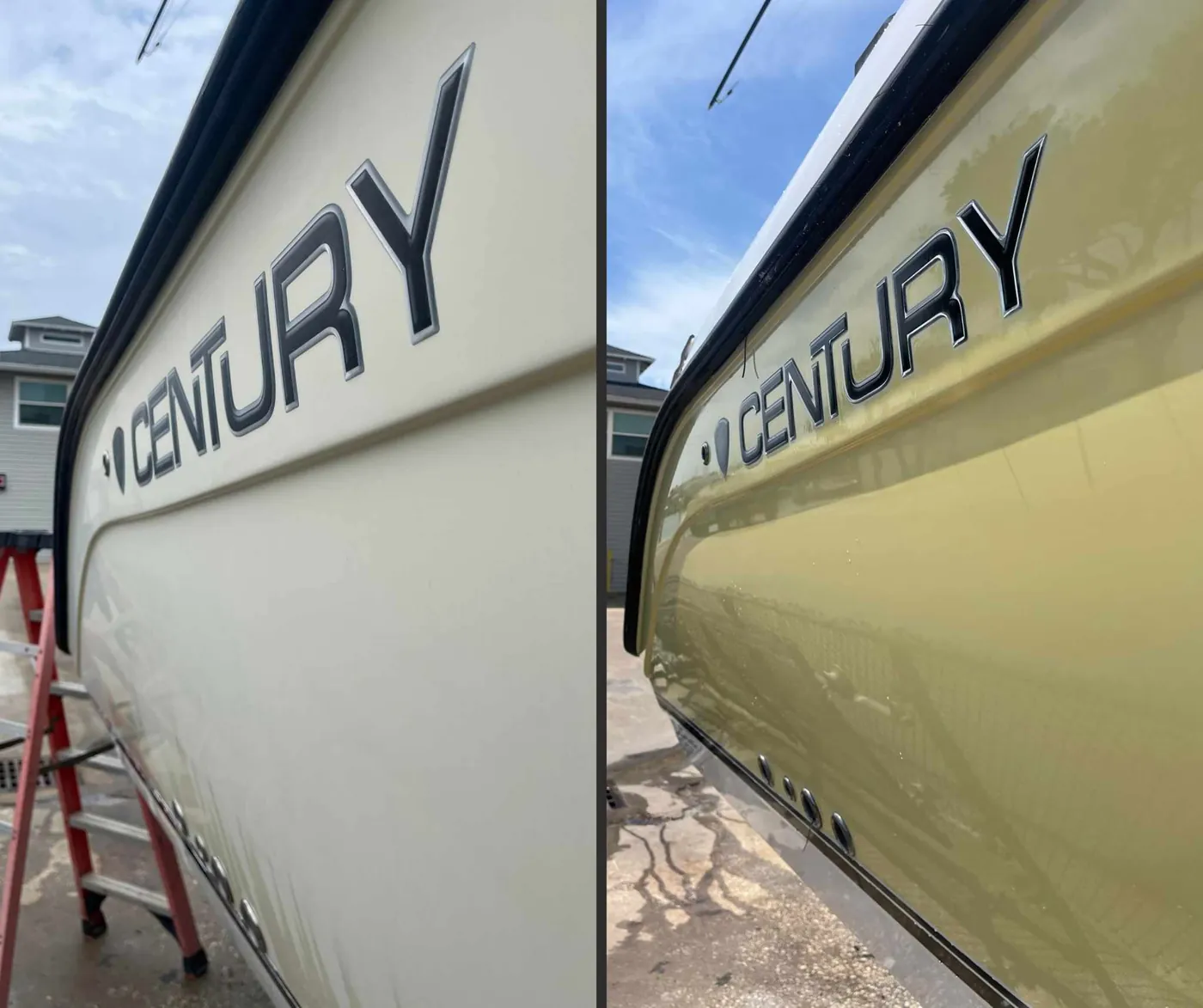
If your boat has been sitting in the Dunedin sun for more than a season without a protective coating, the visual transformation after a full ceramic coating service is going to be significant. The most dramatic change most boat owners notice first is the return of deep, wet-looking gloss to gel coat surfaces that had gone chalky and dull. UV oxidation creates a dry, powdery outer layer on gel coat that scatters light instead of reflecting it, which is why heavily oxidized hulls look faded and lifeless. When we remove that oxidized layer through machine polishing and then apply the ceramic coating on top, the result is a gel coat that looks closer to how it looked when the boat was new. If your hull was originally a bright white, it will look white again rather than the dingy off-white that years of Florida sun creates. If it was a darker color, the depth and richness of that color will come back in a way that's hard to describe until you've seen it in person.
Beyond the hull color and gloss, there are a few other changes that regular Dunedin boat owners typically notice after a ceramic coating service. Non-skid deck areas that were stained gray or brown from embedded salt, fish residue, and algae growth come out looking much cleaner and more uniform after the decontamination and coating process. They're never going to look like brand-new non-skid, but the dramatic staining that accumulates over a season of use on St. Joseph Sound or running out through the Honeymoon Island channel lifts significantly, and the surface becomes much easier to keep clean going forward because the coating reduces how deeply new staining can penetrate. Many boat owners also notice that water behaves differently on their boat's surfaces after ceramic coating. Instead of sitting in flat sheets that leave water spots as they dry, water beads up aggressively and rolls off the surface. That hydrophobic behavior is one of the most visually satisfying aspects of a fresh ceramic coating and also one of the most practical, because it means salt water is spending much less time in contact with your gel coat on every single trip.
It's also worth setting realistic expectations about what ceramic coating won't do. It won't fill deep scratches or repair gel coat damage that has already broken through the surface layer. It won't make old, cracked, or crazing gel coat look new. And it won't last forever without any maintenance. You'll still want to rinse your boat after saltwater use, and you'll want to use a ceramic-safe wash product for routine cleaning rather than harsh soaps that can degrade the coating. With proper care, the protection and appearance benefits of a quality marine ceramic coating in Dunedin's environment typically last the full 18 to 24 months before the coating begins to lose its hydrophobic properties and a fresh application is worth scheduling. Most boat owners who've done it once find the service-to-benefit ratio compelling enough to make it a regular part of their boat maintenance cycle.
What Dunedin Boat Owners Ask
How do I schedule a ceramic coating appointment for my boat in Dunedin?
Scheduling is easy. You can reach us by phone, text, or through the contact form on this page. We typically start with a brief conversation about your boat, its size, how it's stored, and what condition the gel coat is currently in. If possible, a few photos are helpful so we can get a clear sense of how much prep work is involved before we give you a quote. From there, we'll find an appointment time that works with your schedule. We service boats throughout Dunedin and the surrounding Pinellas County waterfront, and our mobile setup means we come directly to your marina slip, private dock, or storage location. Most appointments are confirmed within a day or two of your first contact, and we'll send you a reminder before the scheduled date so you're not left guessing about timing.
Does boat ceramic coating work on all types of boats?
Marine-grade ceramic coating is designed primarily for gel coat surfaces, which is the outer finish layer on the vast majority of fiberglass boats. If your boat is fiberglass, regardless of whether it's a center console, pontoon, sailboat, bowrider, or express cruiser, ceramic coating is a great fit. We work on all of those boat types regularly in the Dunedin area. Aluminum boats and painted hull surfaces can also be treated, though the prep process and specific coating formulation may differ slightly from a standard gel coat application. If you're not sure whether your boat is a good candidate, just describe it to us when you reach out and we'll let you know exactly what we can do for your specific hull material and construction.
How often should I get boat ceramic coating in Dunedin, FL?
For boats kept in Dunedin's saltwater environment, the typical recommendation is every 18 to 24 months. The specific timeline for your boat depends on how it's stored, how frequently it's used, and how diligently you maintain it between applications. Boats kept in wet slips with constant saltwater exposure tend to cycle through the coating's hydrophobic properties faster than boats stored on lifts or kept under a cover. A boat that runs through the Honeymoon Island channel several times a week in summer is also working its coating harder than a boat used casually once or twice a month. We'll give you honest guidance during your post-service walkthrough about when your specific boat is likely to need a fresh application based on its storage situation and use patterns. Getting boat ceramic coating in Dunedin on a regular cycle keeps your hull consistently protected and means less prep work each time since the underlying gel coat isn't being left unprotected between applications.
How does the pricing work and can I get a quote before committing?
We always provide a free quote before any work begins. There are no surprise charges or fees added on after the fact. Our quotes are based on your boat's size, its current gel coat condition, and the scope of prep work involved. A boat that needs only light cleaning before coating is a different job than one that requires extensive machine polishing to address years of UV oxidation, and we price those jobs accordingly. To get a quote, just reach out to us with some basic information about your boat and we'll walk through everything with you. We want you to feel completely comfortable with the scope of work and what it involves before you book an appointment. If your situation changes or you have questions as the job progresses, we stay communicative throughout the process.
Do you work at private docks and residential properties in Dunedin?
Yes, absolutely. A significant portion of our Dunedin work happens at private residential docks and backyard boatlifts rather than at commercial marinas. If you have a dock or lift at your home along the Edgewater Park area, the St. Joseph Sound shoreline, or anywhere else in the Dunedin area, we're comfortable working in that setting. We bring all the equipment we need and connect to the water and power at your dock, so we don't place a burden on your home's utilities or require anything special from your property. We do ask for reasonable access to the dock and enough space to set up safely, but beyond that, working at private properties is completely normal for us. We treat residential properties with care and clean up completely before we leave.
Service Areas Nearby
While Dunedin is a core part of our service territory, Sunrise Marine Detailing LLC works across a wide stretch of the Pinellas County and Tampa Bay waterfront. If you're a boat owner in a neighboring community, there's a very good chance we can come to you just as easily as we serve boats right here in Dunedin. We also detail boats kept in Clearwater and at the marinas along the Clearwater Beach waterfront, which is just a short distance down the coast from Dunedin. Tarpon Springs, with its rich boating tradition and the Anclote River running out to the Gulf, is another area we cover regularly, and the sponge docks community there has a long-standing connection to saltwater boat ownership that we understand and respect. Palm Harbor boat owners along the Lake Tarpon canal system and the northern Pinellas Bay shoreline are also part of our regular service territory. We service boats in Safety Harbor on the eastern side of Tampa Bay, where the calmer water conditions are a contrast to the open Gulf exposure of the Dunedin and Clearwater areas but where UV oxidation is still a significant problem for boats left in the sun. Oldsmar, Seminole, and the Indian Rocks Beach and Indian Shores communities along the Intracoastal Waterway are also areas we travel to regularly. The connecting waterways of this region, from the Gulf Intracoastal to Tampa Bay proper to the smaller sounds and channels that run through Pinellas County, mean that boats in this entire area share similar environmental challenges. Salt, sun, and humidity don't stop at city limits, and neither do we. If you're a boat owner anywhere along this stretch of the Florida Gulf coast and you're looking for professional marine ceramic coating service, we want to hear from you.
We also serve nearby areas, see Dunedin or Pinellas Park for the same boat ceramic coating work.
Get a Free Quote
Your boat works hard in the salt and sun around Dunedin, and it deserves protection that actually holds up to those conditions. If you're ready to talk about boat ceramic coating in Dunedin or just want to understand what the process involves for your specific boat, we make it easy to get started. Text us, call us, or fill out the contact form below and we'll get back to you quickly. Tell us about your boat, where it's kept, whether that's a slip at Dunedin Marina, a lift near St. Joseph Sound, or a private dock along the Edgewater Park waterfront, and we'll put together a free, no-pressure quote tailored to your boat's needs. Sunrise Marine Detailing LLC is here to help you protect your investment. Call (727) 297-8866 schedule a free quote, or see what other Dunedin owners say.